The main aim of this blog is give information all about alternative healing, also to share some of my compilation and research in HERBAL MEDICINE, Acupressure, Reflexology, Acupuncture Points, some healing methods in YOGIKA CHIKITSA (Yogic Treatments), Ayurveda, the other Herbals used by our local healers, always visit for UPDATES...

Friday, May 18, 2012

LEMON GRASS (Herbs Power)

Hindi: Gandhatrana, HarĂ­-chaha
English: Lemon grass
Latin: Andropogon citratus DC. (A. Shoenanthus)

Part Used: Essential oil, herb
Habitat: Grows wild in gardens in India, Sri Lanka, Philippines and other tropics, in cultivated areas
Energetics: Pungent, bitter-cold-pungent PK- (V+excess)
Tissues: Fat, nerves
Systems: Nervous, metabolic
Action: Antispasmodic, diaphoretic, diuretic, emmenagogue, stimulant; oil—carminative, refrigerant, stomachic, tonic

Uses: Bowel spasms, colic, diarrhea, dysmenorrhea (neuralgic), fever, gas, colds, G.I. spasms, intestinal mucus membrane tonic and stimulant; vomiting. Oil/external—bath, perfume, and hair oils; with coconut for lumbago, rheumatism, neuralgia, sprains, pains, ringworm; excellent tea for Pitta and kidneys.

Precautions: None
Preparation: Infusion or decoction of leaves, powder

ALOPECIA (Hair Loss)

Western medical concept:
Researchers have determined that this form of hair loss is related to hormones called androgens, particularly an androgen called dihydrotestosterone. Androgens are important for normal male sexual development before birth and during puberty. Androgens also have other important functions in both males and females, such as regulating hair growth and sex drive.

There are various types of alopecia. A common pattern of male hair loss is that it begins above both temples or at the vertex, and may progress to complete baldness (Figure 6.8). In women, the hair usually becomes thin all
over the head, and the hairline does not recede.

Our head hair is nourished by Kidney yin and Liver Blood. Thinning or loss of hair occurs when overworked or stressed, when there is blood loss or anaemia or when the climate is very dry. Dryness makes the hair brittle and causes split ends. Blood deficiency (also due to stress and overwork, because stress consumes Liver Blood) makes the roots weak, and the individual strands of hair thin and dull. The mechanical strain of washing, combing or even moving the head on the pillow is enough to cause the loss of large handfuls of hair. When treating hair loss, it is necessary to nourish and moisten the hair, and it will flourish again in growth. It is important to initiate treatment as soon as symptoms develop as, once complete baldness sets in, it will be very difficult to make a difference.

I have addressed general hair loss and partial hair loss in certain areas of the head as the two types that give good results with acupuncture. Both energy treatment and local treatment is given. The patient should take some vitamin–amino acid combinations such as Panthovigar N®, which contains thiamine, calcium pantothenate, cystine and keratin, and some local care.

Explaining the treatment:
In hair loss of any type, the Kidney yin must first be tonified, ideally on point K 7. The patient should also drink water more regularly and rest more. Where possible, a midday rest would be excellent, as midday is the worst time energetically for those who have Kidney yin deficiency. If Kidney yin is deficient, this would generate uncontrolled Kidney yang, which rises to the head.

If Liver Blood deficiency can be established, then Blood should be tonified with points Ren 14, UB 15, UB 17, Sp 10, GB 39 and an iron supplement.

The next thing to do would be the local treatment. This is done (a) in the area with hair loss and (b) on the organs associated with the areas of the hair loss.

Local treatment on the area of hair loss:
This area should be examined well. If there is some hair and the scalp has normal roughness, then electrical stimulation should be used. This will cool the scalp in the area.

The technique – electrical stimulation on area of hair loss:
The area with thinning hair is treated with four subcutaneous needles, two on each side, and these are connected to two outlets of an electrical  stimulator (taking care to connect the two needles on the same side of the body to one outlet). The needles are then stimulated at continuous frequency, around 10 Hz, for 20 minutes.

This needling is relatively painful, and is therefore difficult to repeat more than twice weekly for 2 weeks, and then has to be done once weekly for a further four to eight sessions (Figure 6.9).

When there is no hair at all in the affected area, this area can be treated locally with plum-blossom tapping to bleed. The tapping therapy has to be done daily for up to 14 days. It would be more convenient and  practical for the patient to take a plum-blossom hammer home and get a family member to do it for them (Figure 6.10).

The technique – plum-blossom tapping on bald area:
Clean the area well with surgical spirit and allow it to dry. Holding the plum-blossom hammer, tap hard vertically on the bald area with no particular direction. When finished, this area should be covered with droplets of blood, which should be wiped off.

This treatment is very effective in small areas of baldness, or in alopecia areata. It is not as successful in large areas or if the entire head is bald. Within 14 days of treatment, one can see and feel fluff-like hair growing in this area. The initial growth is grey coloured, and is not the colour of the rest of the hair. But within 1–3 months the hair will become thicker and more coloured. Once the ‘fluff’ starts to appear, the bleeding tapping should be stopped. Local treatment is no longer necessary. If needed, electrostimulation could be given (Figure 6.9).

Treatment on the organs associated with hair loss:
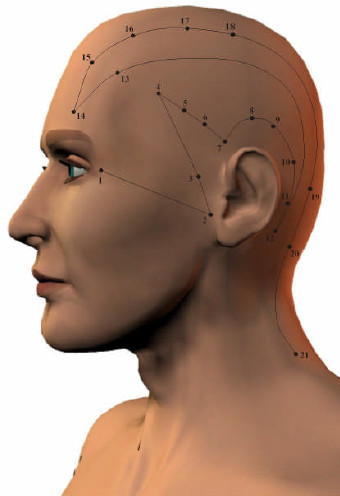
The common areas for hair loss are the temples and vertex. In alopecia areata, it can be anywhere in the head. There is empirical knowledge that different parts of the head are related to different organs of the body, and that imbalances of these particular organs will manifest as pain, hair loss, greying or skin problems in these parts of the head.

According to the table on TRADITIONAL CHINESE MEDICINE VIEW the frontal head (including both temples) is associated with the Stomach and Large Intestine, the bright yang organs. Headache that is due to hunger or low blood sugar will occur in this area. A headache that accompanies gastritis will also manifest in this area. Hair loss in this area is due to excessive heat in the Stomach or Large Intestine (more often the Stomach). Just as hair grows more in areas which are cold, to insulate and protect these areas, so the body will lose hair in areas which are hot, in an attempt to keep cool.

Thus, hair loss only in the area of the Stomach or Large Intestine needs to be treated by balancing the energy there – tonifying the yin and sedating the yang (the yin needs to be tonified, because this is a long-term imbalance and there should be some deficiencies too. As there is heat, the deficiency must be with the yin aspect).

Energy-balancing points for vertex hair loss:

"Balance Liver yin deficiency and yang excess"

■ Liv 5 and GB 40 sedation – Luo-connecting point of yin organ and sedate yuan-source point of yang organ.

■ Avoid sour foods, alcohol and stress, all of which will increase Liver yang aspect.

In the case of both hair loss and premature greying of head hair (the second is a symptom of Kidney yang deficiency), patients seem to express concern only when it is too late. In traditional Chinese medicine, we worry about tendencies of the body rather than extreme symptoms, predominantly because the more chronic and far gone an imbalance, the more difficult it becomes to correct. When imbalances are detected early, however, they are easier to correct and prevent from going into a chronic state.

It is normal to lose hair during climate changes and when the weather is dry, during at least two cycles of the year. But then the hair grows again and returns to the earlier state. If one notices hair loss in large quantities – covering the pillow or the shower base – it is alarmingly high and needs treatment. Because, even if hair grows again, it will be less and thinner than before, and will gradually lead to serious proportions. If we notice hair loss when we are overworked, when we have long periods of poor sleep and when we are generally run down, then we need to treat the hair loss. 

Hair loss – dos and don’ts:
■ Gently massage the scalp with coconut, olive or sesame oil, leave it on for 30 minutes or overnight, and then wash. This will cool and nourish the hair roots and is much better than any conditioner; this can be done once a week.
■ Take a multivitamin product.
■ Take a herbal iron supplement if there is Blood deficiency.
■ Go to bed before midnight.
■ Post-menopausal women, or men of the same age, should have an afternoon rest when ever possible (the heat tends to rise up because of the Kidney yin deficiency).
■ Drink plenty of water regularly. Eat watery foods and greens.
■ Keep head cool (not cold!). If one has a hot head and cold feet, then a warm foot bath will change this order.
■ Don’t wash hair too often – twice weekly is fine. If hair is too greasy, there is a fault with the diet. This can be caused by excessive milk products, cheese, processed meats such as sausage, fatty meats and oily preparations and excessive refined sugars.
■ Avoid close caps and hats when possible: they increase the damp–heat in the head.
■ The hairdryer is not a plumping machine for a head with less hair! It dries and scorches the roots. Do not use a hairdryer regularly unless it is necessary to go out soon after washing the hair – and then keep it at a reasonable distance. Ask your hairdresser (who uses it too close to the scalp) to do the same.
■ Avoid direct sunlight on the head for long. Carry an umbrella if you need to stand in the sun.
■ Avoid coffee and alcohol.


Source:
COSMETIC ACUPUNCTURE, by Radhah Thambirajah

Monday, April 23, 2012

REFLEXOLOGY EAR CHART

Click image for larger view

IRIDOLOGY CHARTS

Click the image for larger view

Click the image for larger view

Click the image for larger view 

Click the image for larger view

Wednesday, April 18, 2012

LI 11 for High Blood Pressure

LI 11

At the lateral end of the elbow crease, halfway between 
LU-5 and the lateral epicondyle of the humerus.

Actions
• Expels Heat, Wind and Dampness
• Cools the Blood
• Benefits the sinews and joints

Principally useful for: Fever, high blood pressure, digestive problems due to Heat, skin diseases, elbow, arm and shoulder problems. How to press it: With the receiver lying supine, the giver sits facing his head. His arm is bent and his elbow cupped in the palm of her outside hand (furthest from him).The giver's thumb is placed on the lateral epicondyle of the humerus, then the tip of her thumb rolled towards the end of his elbow crease, penetrating into the depression in the joint. The supporting hand is used to rotate the arm slightly in order to find the point of deepest penetration. When the penetration is as deep as possible, the giver lays his arm against his body to support it in a bent position, and her free hand is placed on his lower Hara as a mother hand while she continues to penetrate the point.

Tuesday, February 14, 2012

HOMOK HOMOK o parang GULAMANG DAGAT

Shared by: Mike Mesina, originally posted in FB Group
Ang ugat na ito sobrang lambot pag hinawakan mo nakuha ko ito sa puno ng mga kahoy sa bundok na inaakyatan namin papuntang LAKE HOLON sa bayan ng T-BOLI SOUTH COTABATO hindi ko naman alam nung una kung anu ang gamit nito bigla nlang may nagsalita sa pamamagitan ng hangin habang naglalakad ako na mag-isa na kumuha ako at inuwi ko sa amin para magamit ko, nalaman ko sa aking ama isa rin pala ito sa mga binibigay ng mga abyan ng aking yumaong lola para magamit nya sa kanyang mga langis.

Thursday, February 2, 2012

ACUPOINT - Governing Vessel (GV, DU)

Governing Vessel (GV, DU)
The Governing Channel has 28 points

The Du channel starts midway between the tip of the coccyx bone and the anus with patient lying prone. It then flows upward inside the spinal column to the nape of the neck, and ascends to the vertex. Along the forehead, it descends to the nose bridge, then to the lips. Ending at the labial frenulum inside the upper lip.

ACUPOINT - Conception Vessel (CV, Ren)

Conception Vessel Meridian (CV, Ren)
The Directing Channel has 24 points

The Ren channel starts on the midline between the anus and the scrotum in males. Between the anus and the posterior labial commissure in females. It ascends anteriorly to the public region. Along the midline of the abdomen, it flows upward reaches the throat. Flowing further upward, it ends in the depression in the center of the mentolabial groove.

ACUPOINT - Liver Meridian (LV)

Liver Meridian (LV)
The Foot Terminal Yin (Jue Yin) of the Liver 14 points

The liver channel of the Foot-Jueyin originates on the lateral side of the great toe. Ascending along the dorsum of the foot, it flows further upward to the anterior aspect of the medial malleolus. Then it runs upward to the medial side of the knee and along the medial aspect of the thigh into the pubic region. From there it curves around the external genitalia and crosses the midline up to the lower abdomen. Ending directly below the nipple.

ACUPOINT - Gall Bladder Meridian (GB)


Gall Bladder Meridian (GB)
The Foot Lesser Yang (Shao Yang) of the Gall bladder 44 points

The gall bladder channel of the Foot-Shaoyang starts from the outer canthus of the eye, and descends to the anterior aspect of the ear. Then ascends to the corner of the forehead, and then winds downward posterior to the ear. Then arches forward to the forehead at the midpoint of the eyebrow. It then runs above the hairline to the lateral side of the neck. Travels highest point of the trapezius muscle. From there it further descends to the axilla and enters the chest. It then travels interiorly in the hypochondriac region, emerging at the lateral side of the lower abdomen near the femoral artery in the inguinal region. Then it curves along the margin of the public hair and runs transversely into the hip region. It then travels downward along the lateral side of thigh to the lateral side of the knee. Further descending along the anterior aspect of the fibula, it reaches the lower end of the fibula, and the anterior aspect of the lateral malleolus. Following the dorsum of the foot, it terminates at the lateral side of the fourth toe's tip.

ACUPOINT- Triple Warmer Meridian (TW, TB, SJ)

Triple Warmer (San Jiao) Meridian (TW, TB, SJ)
The Hand Lesser Yang (Shao Yang) of the San Jiao 23 points

The sanjiao channel of the Hand-Shaoyang originates from the tip of the ring finger. It travels upward between the fourth and fifth metacarpal bones and along the dorsal side of the wrist and the lateral side of the forearm between the radius and ulna, it passes through the olecranon. Then it runs along the lateral aspect of the upper arm and reaches the shoulder region. Crossing over the shoulder, it enters the supraclavicular fossa. It then ascends to the neck, running along the posterior border of the ear. It crosses from the superior aspect of the ear to the corner of the forehead. Then it turns downward to the cheek and terminates in the depression at the lateral end of the eyebrow.

ACUPOINT - Perciardium Meridian (P, PC)

Pericardium Meridian (P, PC)
The Hand Terminal Yin (Jue Yin) of the Pericardium 9 points

The pericardium channel of the Hand-Jueyin originates in the chest lateral to the nipple. It then ascends to the axillary fossa and runs along the medial aspect of the upper arm, passing through the cubital fossa. It goes further downward to the forearm between the tendons of the m. palmaris longus and m. flexor carpi radialis. It enters the palm and passes along the middle finger to its tip.

ACUPOINT - Kidney Meridian (KI)

Kidney Meridian (KI)

KI 1
Kidney Meridian (KI)
The Foot Lesser Yin (Shao Yin) of the Kidney 27 points

The kidney channel of the Foot-Shaoyin starts from the interior aspect of the little toe (On the sole of the foot,  depending on the text.), and runs through a depression in the lower aspect of the tuberosity of the navicular bone. It travels behind the medial malleolus and encircles the malleolus. Ascending along the medial side of the leg, it passes the medial side of the popliteal fossa and goes further upward along the posterior-medial aspect of the thigh. Traveling to the superior border of the symphysis pubis forming a straight line 0.5 cun from the midline. It ascends diverging at the diaphragm, ending in a depression on lower border of clavicle 2 cun from the midline.

ACUPOINT - BLADDER MERIDIAN (BL, UB)

Bladder Meridian (BL)

Bladder Meridian (BL)

Bladder Meridian (BL)

Bladder Meridian (BL)
Bladder Meridian (BL, UB)
The Foot Greater Yang (Tai Yang) of the Bladder 67 points

The urinary bladder channel of the Foot-Taiyang originates from the inner canthus of the eye. Passing through the forehead, it flows up to the vertex. It bifurcates above the posterior hairline into two lines. One line runs from the posterior aspect of the neck downward along the medial border of the scapula (3 cun lateral to the back mid-line). Passing through the gluteal region. Another line runs straight downward (1.5 cun lateral to the mid-line of the back) to the lumbar region. From there it descends along the posterior aspect of the thigh to the popliteal fossa. Descending to the posterior aspect of the gastrocnemius muscle and further to the posterior inferior aspect of the lateral malleolus. Ending at lateral posterior side of the tip of the little toe.

ACUPOINT - SMALL INTESTINE MERIDIAN (SI)

Small Intestine Meridian (SI)
The Hand Greater Yang (Tai Yang) of the Small Intestine 19 points

The small intestine channel of the Hand-Taiyang starts at the ulnar aspect of the tip of the little finger, and travels along the ulnar border of the hand dorsum upward to the posterior border of the lateral aspect of the upper arm. It passes through the cubital region curving around the scapular region. Then turning downward to the supraclavicular fossa and ascends to the neck. Travels up to the cheek going through the outer canthus of the eye, and ends anterior to the tragus of the ear.